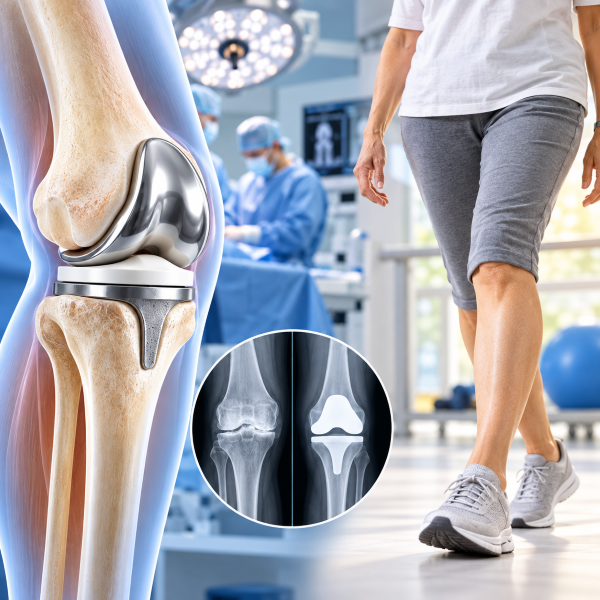
Total and Partial Knee Replacement Surgery by Dr. Girish Dhanawat
Living with persistent knee pain can make everyday activities such as walking, climbing stairs, standing for long periods or getting up from a chair increasingly difficult. When knee arthritis progresses and medicines, physiotherapy and other non-surgical treatments no longer provide adequate relief, knee replacement surgery may help reduce pain and restore mobility.
Knee replacement surgery in Thane is a well-established orthopaedic procedure that involves replacing damaged joint surfaces with artificial components designed to support smoother knee movement and improved joint function.
Dr. Girish Dhanawat, an Orthopedic Surgeon and Joint Replacement Specialist in Thane, provides personalised assessment and treatment for knee arthritis, joint degeneration and mobility problems. His approach focuses on accurate diagnosis, careful surgical planning, appropriate treatment selection and rehabilitation.
Whether you are considering total knee replacement, partial knee replacement or exploring surgical options for advanced knee arthritis, a detailed consultation can help determine the most suitable treatment for your condition.
Book a Knee Replacement ConsultationWhat Is Knee Replacement Surgery?
Knee replacement surgery, also called knee arthroplasty, is a surgical procedure used to treat severe knee joint damage, most commonly caused by advanced osteoarthritis.
The knee joint is formed by the thigh bone (femur), shin bone (tibia) and kneecap (patella). These bones are covered by smooth cartilage that allows comfortable movement.
Over time, arthritis can damage this protective cartilage, causing the joint surfaces to become rough and inflamed. This may result in pain, stiffness, swelling and difficulty moving the knee.
During knee replacement surgery, the orthopaedic surgeon removes damaged bone and cartilage surfaces and replaces them with artificial components made from medical-grade materials such as metal and specialised plastic.
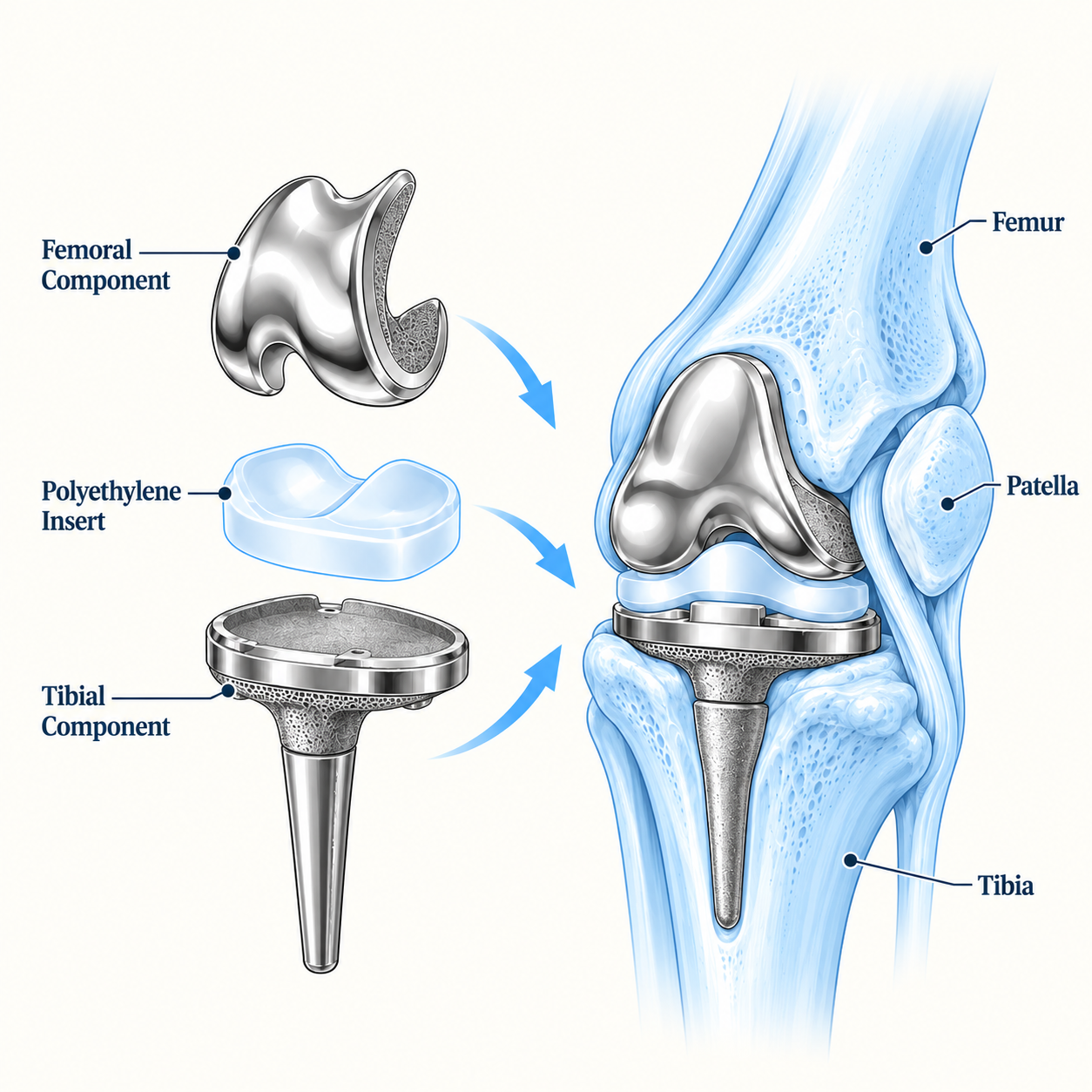
The aim of surgery is to:
- Reduce persistent knee pain
- Improve knee movement and joint stability
- Correct certain arthritis-related knee deformities
- Restore the ability to perform everyday activities
- Improve mobility and quality of life
Knee replacement does not involve replacing the entire knee with a completely new joint. Instead, the damaged joint surfaces are resurfaced using carefully selected implants.
Who May Need Knee Replacement Surgery in Thane?
Knee replacement may be recommended for patients with advanced joint damage who continue to experience significant pain and difficulty performing daily activities despite appropriate non-surgical treatment.
1. Advanced Knee Osteoarthritis
Osteoarthritis is one of the most common reasons for knee replacement surgery.
It occurs when the cartilage protecting the knee joint gradually deteriorates, resulting in pain, stiffness, swelling and reduced movement.
Patients with advanced osteoarthritis may experience discomfort even during short walks or routine household activities.
2. Rheumatoid Arthritis
Rheumatoid arthritis is an autoimmune inflammatory condition that can progressively damage the knee joint.
When inflammation causes severe joint destruction and medical treatment no longer provides sufficient symptom control, knee replacement may be considered.
3. Severe Knee Pain Affecting Daily Activities
Persistent knee pain that makes walking, climbing stairs, getting dressed or sleeping difficult may indicate the need for further orthopaedic evaluation.
Surgery may become an option when appropriate conservative treatments have failed to provide adequate relief.
4. Bow-Legged or Knock-Kneed Deformity
Advanced arthritis can alter the normal alignment of the knee, resulting in bow-legged or knock-kneed deformities.
Knee replacement surgery may help improve joint alignment, stability and function.
5. Severe Knee Stiffness and Limited Mobility
Patients who struggle to bend or straighten their knees because of advanced joint degeneration may benefit from surgical assessment.
6. Post-Traumatic Knee Arthritis
Previous fractures, ligament injuries or significant knee trauma can sometimes lead to early joint degeneration.
When damage becomes advanced and symptoms substantially affect everyday life, knee replacement may be considered.
Not everyone with knee arthritis requires surgery. Dr. Girish Dhanawat evaluates symptoms, examination findings, X-rays, general health and response to previous treatment before recommending knee replacement.
Types of Knee Replacement Surgery
Different knee replacement procedures are available depending on the location and severity of joint damage.
1. Total Knee Replacement (TKR)
Total knee replacement is a commonly performed procedure for advanced arthritis affecting multiple areas of the knee joint.
During surgery, damaged surfaces of the thigh bone and shin bone are resurfaced and replaced with artificial components. The kneecap surface may also be resurfaced when appropriate.
Total knee replacement may be recommended when arthritis affects more than one compartment of the knee and causes substantial pain and mobility limitations.
2. Partial Knee Replacement (PKR)
Partial knee replacement, also known as unicompartmental knee replacement, involves replacing only the damaged compartment of the knee.
This procedure may be suitable for selected patients whose arthritis is limited to one part of the joint and whose remaining joint structures meet the necessary criteria.
Potential advantages for appropriately selected patients include preservation of more natural knee structures and, in some cases, a faster early recovery.
However, not everyone is suitable for partial knee replacement.
3. Bilateral Knee Replacement
Bilateral knee replacement involves replacing both knee joints.
Depending on the patient's overall health, arthritis severity and surgical risk, the procedures may be performed:
Simultaneously: Both knees are replaced during one surgical session.
In stages: Each knee is replaced during a separate operation.
The safest approach depends on individual medical circumstances.
4. Robotic-Assisted Knee Replacement
Robotic-assisted knee replacement computer-based technology to support surgical planning, bone preparation and implant positioning.
The surgeon remains responsible for controlling the operation and making clinical decisions.
Robotic assistance may improve the precision of certain surgical steps, although superior long-term outcomes compared with well-performed conventional knee replacement have not been consistently established.
Benefits of Knee Replacement Surgery
For appropriately selected patients with advanced knee arthritis, knee replacement surgery can offer meaningful improvements in comfort and mobility.
Significant Reduction in Knee Pain
One of the primary objectives of knee replacement is to reduce chronic arthritis-related pain that has not responded adequately to conservative treatment.
Improved Walking Ability
After recovery and rehabilitation, many patients experience improved walking comfort and are able to perform daily activities with less difficulty.
Better Knee Alignment
Knee replacement can help correct certain deformities associated with advanced arthritis, improving the mechanical alignment of the joint.
Improved Joint Movement and Stability
The procedure aims to restore functional knee movement and provide a stable joint for routine activities.
Greater Independence
Reduced pain and improved mobility can make everyday activities such as shopping, household work and climbing stairs more manageable.
Long-Term Symptom Relief
Modern knee implants can provide long-lasting relief for many patients. Implant longevity varies according to patient factors, implant characteristics, activity level and surgical considerations.
Although knee replacement has a strong record of effectiveness, outcomes differ between individuals. Some patients continue to experience stiffness, discomfort or functional limitations after surgery.
How Is Knee Replacement Surgery Performed?
Knee replacement surgery follows a structured process involving clinical assessment, surgical planning, implant placement and postoperative rehabilitation.
Step 1: Detailed Knee Evaluation
Dr. Girish Dhanawat assesses the patient's symptoms, medical history, walking pattern, knee mobility and joint alignment.
Weight-bearing X-rays are commonly used to evaluate the severity and distribution of arthritis. Additional investigations may be recommended when clinically necessary.
Step 2: Preoperative Assessment and Planning
Before surgery, the patient undergoes a medical evaluation to assess fitness for the procedure.
This may include blood investigations, assessment of existing medical conditions, medication review and anaesthesia evaluation.
The surgeon selects the appropriate knee replacement procedure and plans the implant positioning based on the patient's anatomy and clinical requirements.
Step 3: Anaesthesia and Surgical Preparation
Knee replacement surgery is performed under suitable anaesthesia, which may include spinal or general anaesthesia depending on the patient's condition and the anaesthesia team's assessment.
The surgical team follows established infection-prevention and safety protocols.
Step 4: Removal of Damaged Joint Surfaces
The surgeon makes an incision to access the knee joint.
Damaged cartilage and small portions of underlying bone are carefully removed from the affected joint surfaces.
The bone is prepared to accommodate the selected knee replacement components.
Step 5: Placement of Artificial Knee Implants
The artificial components are positioned on the prepared joint surfaces.
A specialised plastic insert is generally placed between the metal components to allow smooth movement.
The surgeon evaluates alignment, stability and the knee's range of motion before completing the procedure.
Step 6: Wound Closure and Postoperative Care
After checking the joint's movement and stability, the surgical incision is closed and covered with a dressing.
The patient is monitored following surgery, with attention to pain control, circulation and early recovery.
Step 7: Physiotherapy and Rehabilitation
Rehabilitation usually begins soon after surgery, depending on medical fitness and the treating team's instructions.
Physiotherapy focuses on restoring knee movement, improving muscle strength, supporting safe walking and gradually increasing functional independence.
Total Knee Replacement vs Partial Knee Replacement
| Feature | Total Knee Replacement | Partial Knee Replacement |
|---|---|---|
| Joint area treated | Resurfaces multiple knee compartments | Resurfaces one damaged compartment |
| Suitable for | More widespread knee arthritis | Arthritis confined to one compartment |
| Natural structures | More joint surfaces are replaced | More natural structures are preserved |
| Surgical approach | More extensive joint resurfacing | Less extensive resurfacing |
| Recovery | Gradual recovery with rehabilitation | Early recovery may be faster in selected patients |
| Implant durability | Well-established long-term outcomes | Depends on selection and remaining joint health |
| Future surgery | Revision may eventually be necessary | Conversion to total replacement may be necessary |
| Patient selection | Suitable for many patients with advanced arthritis | Requires specific clinical criteria |
The decision between total and partial knee replacement depends on arthritis distribution, ligament function, joint alignment, symptoms and overall patient health.
Conventional vs Robotic Knee Replacement Surgery
Both conventional and robotic-assisted knee replacement procedures aim to reduce pain and restore knee function by replacing damaged joint surfaces.
| Feature | Conventional Knee Replacement | Robotic Knee Replacement |
|---|---|---|
| Surgical planning | Surgeon-led planning | Computer-assisted planning |
| Implant positioning | Conventional surgical instruments | Robotic guidance supports positioning |
| Bone preparation | Mechanical cutting guides | Technology-assisted guidance |
| Surgeon control | Surgeon performs the procedure | Surgeon controls the robotic-assisted procedure |
| Technical accuracy | Can achieve excellent accuracy | May improve accuracy of selected steps |
| Rehabilitation | Structured physiotherapy | Structured physiotherapy |
| Long-term outcomes | Well-established effectiveness | Long-term superiority is not consistently established |
| Cost | Often relatively lower | May involve additional technology charges |
The most suitable approach depends on the patient's condition, surgical requirements, available technology and an informed discussion with the orthopaedic surgeon.
Recovery After Knee Replacement Surgery
Recovery after knee replacement involves gradual healing, rehabilitation and improvement in joint function.
The recovery timeline varies according to age, preoperative mobility, muscle strength, medical conditions and type of surgery.
First 24–48 Hours
Many patients begin standing and walking with assistance within the first day after surgery, when medically appropriate.
Early recovery focuses on pain management, circulation exercises, safe movement and prevention of complications.
A walker or other walking aid may be recommended.
First 2 Weeks
During the initial recovery period, patients focus on wound care, controlling swelling, following prescribed medication instructions and participating in physiotherapy.
Exercises are designed to improve knee bending, straightening and muscle activation.
Weeks 3–6
Patients often gradually increase walking distance and participation in daily activities.
Physiotherapy continues to focus on knee flexibility, strength, gait and balance.
Some patients may transition away from walking aids as their confidence and stability improve.
Weeks 6–12
Many patients notice significant progress in mobility and functional independence during this stage.
Activities such as walking outdoors, climbing stairs and returning to selected daily routines may become easier.
Long-Term Recovery
Muscle strength, endurance and knee comfort can continue improving for several months after surgery.
Some patients may take up to a year to achieve their more complete functional recovery.
Following the recommended rehabilitation plan and attending follow-up appointments are important parts of recovery.
Precautions After Knee Replacement Surgery
Patients are generally advised to follow specific precautions during the recovery period.
These may include:
- Taking prescribed medicines as directed
- Attending scheduled physiotherapy sessions
- Keeping the wound clean and following dressing instructions
- Using recommended walking aids until walking is safe
- Avoiding sudden twisting movements or unsupported high-impact activities during early recovery
- Managing swelling according to medical advice
- Following instructions about driving and returning to work
- Attending routine postoperative assessments
Patients should seek urgent medical assessment if they develop chest pain, breathlessness, significant calf swelling or pain, fever, wound discharge or rapidly worsening knee symptoms.
Long-term activity recommendations depend on the type of implant, recovery progress and individual medical circumstances.
How Long Does a Knee Replacement Last?
Modern knee replacement implants are designed to withstand everyday movement and provide durable joint function.
Many implants function for 15–20 years or longer, although their lifespan varies.
Factors that may influence implant longevity include:
- Type and design of the implant
- Accuracy of implant placement
- Body weight and physical activity
- Quality of surrounding bone
- Muscle strength and joint stability
- Infection or other postoperative complications
- Individual wear patterns
Some implants may eventually require revision surgery due to wear, loosening, infection or other problems.
Regular follow-up with the treating orthopaedic surgeon helps assess knee function and implant condition over time.
What Is the Cost of Knee Replacement Surgery in Thane?
The cost of knee replacement surgery in Thane varies depending on the type of procedure, hospital facilities, implant selection and individual medical requirements.
Several factors influence the overall treatment cost.
Type of Knee Replacement
The cost may differ between partial knee replacement, total knee replacement and bilateral knee replacement.
Implant Selection
Different implant designs, materials and manufacturers may have different costs.
Surgical Technology
Robotic-assisted surgery may involve additional technology-related charges compared with conventional knee replacement.
Hospital and Surgical Charges
Hospital facilities, operating theatre charges, surgeon fees, anaesthesia charges and room selection can influence the final cost.
Medical Investigations and Hospital Stay
Preoperative investigations, existing medical conditions, duration of hospitalisation and medication requirements may affect treatment expenses.
Physiotherapy and Rehabilitation
Postoperative rehabilitation, follow-up consultations and additional support services may contribute to the overall cost.
Insurance Coverage
Health insurance coverage depends on the patient's policy, eligibility, waiting periods, exclusions and applicable conditions.
A personalised cost estimate can be provided after clinical evaluation and confirmation of the recommended procedure and hospital.
Patients should clarify which expenses are included in the proposed surgical package.
Why Consult Dr. Girish Dhanawat for Knee Replacement Surgery in Thane?
Choosing the right knee replacement surgeon is an important part of treatment planning. Accurate diagnosis, appropriate surgical recommendations and structured postoperative care can influence patient recovery and satisfaction.
Orthopaedic and Joint Replacement Care
Dr. Girish Dhanawat, MBBS, D. Ortho., is an Orthopedic Surgeon and Joint Replacement Specialist in Thane who provides evaluation and treatment for knee arthritis, hip conditions and other orthopaedic problems.
Personalised Treatment Planning
Every patient's joint condition, mobility limitations, general health and treatment goals are different.
Dr. Dhanawat evaluates these factors before recommending non-surgical treatment, partial knee replacement or total knee replacement.
Conventional and Robotic Surgical Options
Patients can discuss conventional and robotic-assisted knee replacement approaches based on their individual requirements and the technology available at the treating hospital.
Patient-Centred Approach
The consultation process focuses on helping patients understand their diagnosis, available treatment choices, expected benefits, potential surgical risks and rehabilitation requirements.
Focus on Rehabilitation and Recovery
Successful knee replacement care extends beyond the surgical procedure.
Postoperative guidance, physiotherapy and regular follow-up assessments are important for restoring mobility and supporting long-term joint function.
When Should You Consult a Knee Replacement Specialist?
Consider consulting a knee replacement specialist in Thane if you experience:
- Persistent knee pain despite recommended medication or physiotherapy
- Difficulty walking even short distances
- Severe stiffness after sitting or resting
- Knee pain that interferes with sleep
- Difficulty climbing stairs or getting out of a chair
- Recurrent knee swelling
- Progressive bow-legged or knock-kneed deformity
- Reduced independence because of knee pain

An orthopaedic assessment helps determine whether continued non-surgical management or knee replacement surgery is appropriate.
Frequently Asked Questions About Knee Replacement Surgery in Thane
What is knee replacement surgery?
Knee replacement surgery is a procedure in which damaged knee joint surfaces are replaced with artificial components. It is commonly recommended for selected patients with severe arthritis who continue to experience pain and restricted mobility despite non-surgical treatment.
Who is the right candidate for knee replacement surgery?
Patients with advanced knee arthritis, persistent pain, significant movement limitations and inadequate relief from conservative treatment may be candidates. The decision depends on clinical examination, imaging, general health and individual treatment goals.
What is the difference between total and partial knee replacement?
Total knee replacement resurfaces multiple compartments of the knee, while partial knee replacement treats only one damaged compartment. Partial replacement is suitable for selected patients whose arthritis is limited to a specific area of the joint.
Is knee replacement surgery painful?
Anaesthesia prevents surgical pain during the procedure. Postoperative discomfort is expected, particularly during early recovery, but can generally be managed with prescribed pain medication, physiotherapy and other recovery measures.
How long does knee replacement surgery take?
The duration varies depending on surgical complexity, implant type and whether one or both knees are being treated. A straightforward primary total knee replacement commonly takes approximately one to two hours of operative time, although overall time in the operating area is longer.
How many days of hospitalisation are required after knee replacement?
The length of hospital stay depends on medical fitness, pain control, mobility and recovery progress. Some patients are discharged within one to three days, while others may require a longer stay.
How long does recovery take after knee replacement surgery?
Many patients start walking with assistance within the first day. Basic functional recovery often progresses over 6–12 weeks, while strength, movement and comfort may continue improving for several months or longer.
How long does an artificial knee joint last?
Many modern knee replacements continue functioning for 15–20 years or longer. Implant longevity depends on patient activity, body weight, surgical factors, implant design and other individual considerations.
Can both knees be replaced at the same time?
Both knees can sometimes be replaced during the same operation. However, simultaneous bilateral knee replacement is not suitable for everyone. The decision depends on medical fitness, surgical risk and the recommendation of the treating orthopaedic team.
Is robotic knee replacement better than conventional knee replacement?
Robotic technology may improve the accuracy of certain surgical steps, including implant positioning. However, research has not consistently shown better long-term outcomes compared with conventional knee replacement. Both approaches can be effective when appropriately performed.
Can I climb stairs after knee replacement surgery?
Many patients gradually return to stair climbing as strength and mobility improve. Initially, a handrail or assistance may be necessary. The physiotherapist provides instructions for safe stair climbing during rehabilitation.
Can I sit cross-legged or squat after knee replacement?
Deep squatting and sitting cross-legged may remain uncomfortable or difficult for some patients after knee replacement. The ability to perform these movements depends on implant characteristics, preoperative flexibility, rehabilitation and individual recovery. These activities should not be forced.
What is the cost of knee replacement surgery in Thane?
The cost varies depending on the type of surgery, implant selection, hospital, surgical technology and rehabilitation needs. A personalised estimate can be provided following clinical assessment and surgical planning.
Is knee replacement surgery safe for elderly patients?
Knee replacement can be considered in older adults when the expected benefits outweigh the risks. Age alone does not determine eligibility. Overall medical fitness, existing conditions and functional requirements are important considerations.
Where can I consult a knee replacement surgeon in Thane?
Patients can consult Dr. Girish Dhanawat, Orthopedic Surgeon and Joint Replacement Specialist, at his clinic in Naupada, Thane West, for evaluation of knee arthritis and discussion of knee replacement options.
Consult Dr. Girish Dhanawat for Knee Replacement Surgery in Thane
Chronic knee pain should not have to define your everyday activities. If advanced arthritis has made walking, climbing stairs or performing routine tasks difficult, an orthopaedic consultation can help you understand your treatment options.
Dr. Girish Dhanawat offers personalised knee arthritis assessment and joint replacement consultations in Thane, with an emphasis on accurate diagnosis, appropriate surgical planning and rehabilitation.
Whether you are considering total knee replacement, partial knee replacement or robotic-assisted surgery, the first step is understanding which treatment is suitable for your condition.
Dr. Girish Dhanawat MBBS, D. Ortho. Orthopedic Surgeon & Joint Replacement Specialist
Clinic Address: 1st Floor, Office No. 5, Lokmanya Co-Operative Housing Society, 6, Veer Savarkar Marg, Near Gajanan Maharaj Mandir, Naupada, Thane West, Maharashtra – 400602.
Contact: +91 9004700318
Book Your Knee Replacement Consultation