
Advanced Knee and Hip Joint Replacement Care by Dr. Girish Dhanawat
Joint pain can gradually affect your mobility, independence and quality of life. Simple activities such as walking, climbing stairs, sitting comfortably or getting out of bed may become difficult when joints are severely damaged by arthritis, injury or other medical conditions.
When persistent joint pain does not improve with medication, physiotherapy, lifestyle modifications or other appropriate treatments, joint replacement surgery may be considered to relieve pain and improve movement.
Joint replacement surgery in Thane involves replacing damaged joint surfaces with specially designed artificial implants. The procedure is most commonly performed on the knee and hip joints, helping selected patients regain mobility and return to everyday activities with greater comfort.
Dr. Girish Dhanawat, an Orthopedic Surgeon and Joint Replacement Specialist in Thane, provides personalised evaluation and surgical treatment planning for patients experiencing advanced knee and hip conditions. His approach focuses on accurate diagnosis, appropriate patient selection, surgical precision and structured postoperative rehabilitation.
Whether you are considering knee replacement, hip replacement or exploring available surgical options for advanced joint arthritis, a specialist consultation can help determine the most suitable treatment.
Book a Joint Replacement ConsultationWhat Is Joint Replacement Surgery?
Joint replacement surgery, also known as arthroplasty, is an orthopaedic procedure in which damaged joint surfaces are removed and replaced with artificial components designed to restore smoother movement and improve joint function.
Healthy joints contain protective cartilage that allows bones to move against each other with minimal friction.
Conditions such as osteoarthritis, rheumatoid arthritis, fractures and certain bone disorders can damage cartilage and underlying bone, leading to persistent pain, inflammation, stiffness and reduced mobility.
During joint replacement surgery, the orthopaedic surgeon removes the damaged surfaces and replaces them with implants made from biocompatible materials such as metal, specialised plastic or ceramic.
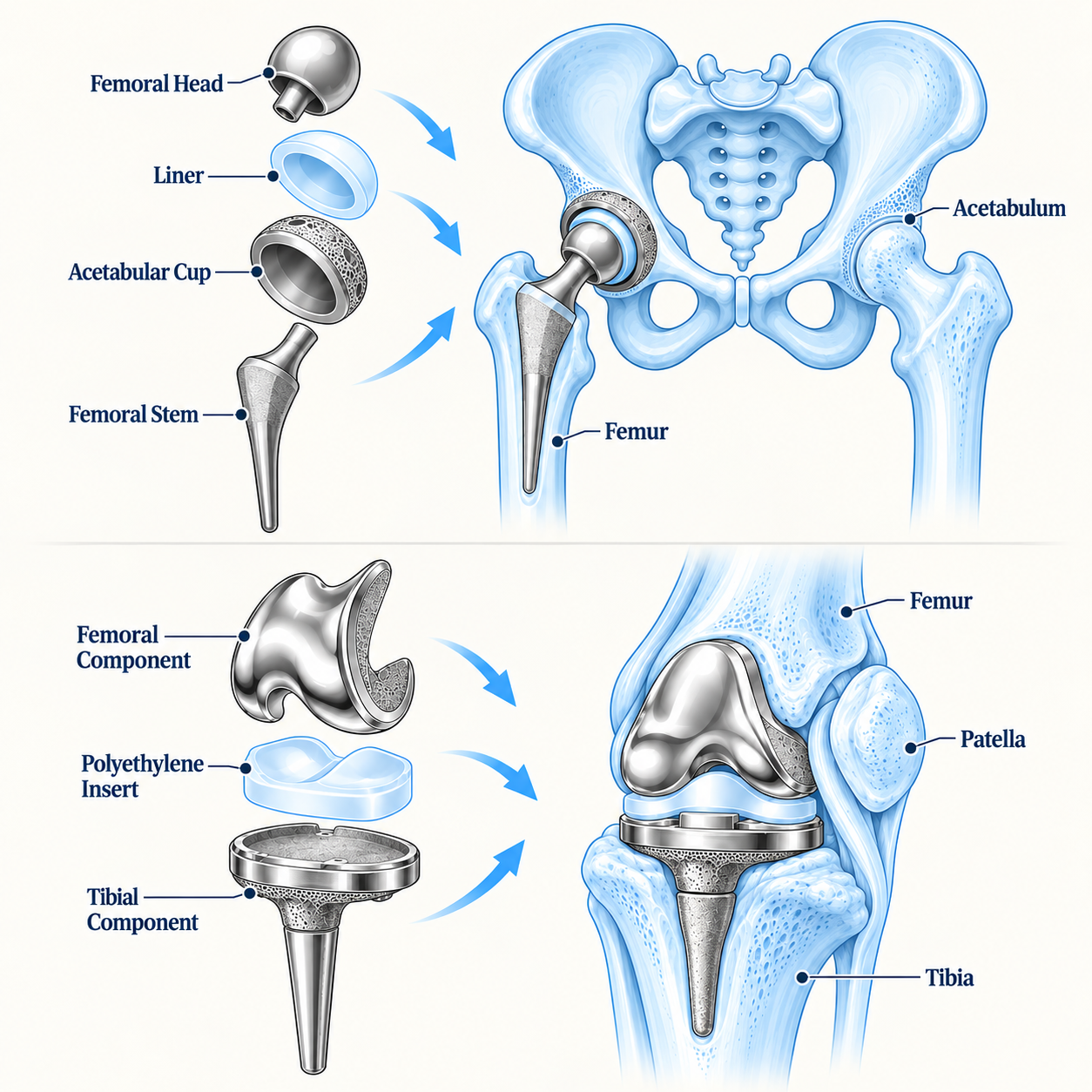
The main objectives of joint replacement surgery are to:
- Relieve severe joint pain
- Improve joint movement and stability
- Restore mobility and functional independence
- Correct selected joint deformities
- Support a return to everyday activities
- Improve overall quality of life
The type of procedure, implant and surgical technique depends on the affected joint, extent of damage, patient's general health and functional requirements.
Who May Need Joint Replacement Surgery in Thane?
Joint replacement may be considered for patients with advanced joint damage who experience ongoing pain and significant limitations despite appropriate non-surgical treatment.
1. Severe Osteoarthritis
Osteoarthritis is one of the most common reasons for knee and hip replacement surgery.
It develops when the cartilage covering joint surfaces gradually wears away, leading to pain, stiffness, inflammation and restricted movement.
In advanced cases, patients may experience difficulty walking, standing, climbing stairs or completing daily activities.
2. Rheumatoid Arthritis
Rheumatoid arthritis is an inflammatory autoimmune condition that can damage multiple joints.
When joint destruction progresses despite appropriate medical management, replacement surgery may be considered to relieve pain and improve function.
3. Avascular Necrosis of the Hip
Avascular necrosis, also called osteonecrosis, occurs when the blood supply to part of a bone is disrupted.
In the hip, this can cause damage and eventual collapse of the femoral head.
Advanced avascular necrosis may require total hip replacement when joint preservation is no longer feasible.
4. Severe Joint Pain Affecting Daily Activities
Persistent pain that interferes with walking, sleeping, sitting or performing everyday tasks may indicate advanced joint deterioration.
Surgical evaluation may be appropriate when conservative treatments no longer provide satisfactory relief.
5. Joint Deformity or Instability
Advanced arthritis can alter the normal alignment and stability of joints.
Examples include bow-legged or knock-kneed knee deformities and certain hip abnormalities associated with degenerative joint disease.
Joint replacement may help restore appropriate alignment and improve stability in selected patients.
6. Joint Damage Following Injury
Previous fractures, ligament injuries or significant trauma can sometimes lead to long-term joint deterioration.
Certain severe hip fractures may also require joint replacement, depending on the patient's age, fracture characteristics and medical condition.
7. Reduced Joint Mobility and Stiffness
Advanced joint degeneration may cause severe stiffness, difficulty bending the knee, restricted hip movement and problems with routine activities.
Joint replacement may be considered when these limitations substantially affect quality of life.
Not every patient with joint pain or arthritis requires surgery. Dr. Girish Dhanawat evaluates symptoms, imaging findings, physical examination results, medical history and response to previous treatment before discussing surgical options.
Types of Joint Replacement Surgery
Joint replacement procedures vary depending on which joint is affected and the extent of damage.
1. Total Knee Replacement (TKR)
Total knee replacement is commonly performed for advanced knee arthritis affecting multiple joint compartments.
During surgery, damaged surfaces of the thigh bone and shin bone are resurfaced using artificial components.
The procedure aims to reduce chronic knee pain, improve alignment and restore functional movement.
Patients with severe knee osteoarthritis, progressive deformity and significant mobility limitations may be considered for total knee replacement.
2. Partial Knee Replacement (PKR)
Partial knee replacement involves replacing only the damaged compartment of the knee joint.
It may be appropriate for selected patients whose arthritis is limited to one area and whose remaining knee structures meet the necessary criteria.
Potential advantages include preservation of more natural joint structures and, in some cases, faster early recovery.
3. Total Hip Replacement (THR)
Total hip replacement is a surgical procedure in which the damaged femoral head and hip socket surfaces are replaced with artificial components.
It may be recommended for advanced hip osteoarthritis, avascular necrosis, selected hip fractures and other conditions causing severe joint damage.
The procedure aims to reduce hip pain, improve walking comfort and restore functional hip movement.
4. Hip Replacement via Direct Anterior Approach (DAA)
The Direct Anterior Approach is one surgical technique used to perform total hip replacement.
In this approach, the surgeon accesses the hip joint from the front, working between muscle groups rather than routinely detaching major muscles.
Potential advantages for selected patients may include reduced muscle disruption and improved early mobility.
However, DAA is not suitable for every patient, and long-term outcomes depend on many factors beyond the surgical approach.
The choice of approach depends on the surgeon's assessment, patient anatomy, implant requirements and surgical considerations.
5. Robotic-Assisted Knee Replacement
Robotic-assisted knee replacement combines the surgeon's expertise with computer-assisted technology to support surgical planning and implant positioning.
Depending on the robotic platform, the system may provide detailed information about knee alignment, anatomy and bone preparation.
The surgeon remains in control throughout the procedure.
Robotic assistance may improve the precision of certain technical steps, although it has not consistently demonstrated superior long-term outcomes compared with well-performed conventional surgery.
6. Revision Joint Replacement Surgery
Revision joint replacement involves removing or replacing some or all components of a previously implanted artificial joint.
It may be required because of implant loosening, infection, instability, fracture, wear or other complications.
Revision surgery is generally more complex than primary joint replacement and requires detailed evaluation and specialised surgical planning.
Patients requiring revision procedures should discuss the availability of appropriate expertise and facilities with their treating orthopaedic specialist.
Benefits of Joint Replacement Surgery
Joint replacement can provide meaningful improvements in pain relief and mobility for appropriately selected patients with advanced joint disease.
Significant Pain Relief
One of the main goals of joint replacement is to reduce persistent pain caused by severely damaged joint surfaces.
Many patients experience substantial improvement in arthritis-related discomfort following recovery.
Improved Mobility
Joint replacement can help patients walk more comfortably and perform everyday activities with fewer limitations.
Better Joint Stability and Alignment
Surgery may help restore joint alignment and improve stability, particularly when advanced arthritis has caused deformity.
Improved Quality of Life
Reduced pain and improved movement may make it easier to participate in family activities, household tasks and social routines.
Increased Functional Independence
Patients may regain the ability to perform certain daily activities with less assistance after successful surgery and rehabilitation.
Long-Term Improvement in Joint Function
Modern joint implants are designed to provide durable function over many years.
However, implant longevity and functional outcomes vary depending on patient characteristics, implant design, activity level and other clinical factors.
Joint replacement does not guarantee complete pain relief or unrestricted movement. Realistic expectations and rehabilitation remain important for achieving a satisfactory outcome.
How Is Joint Replacement Surgery Performed?
Joint replacement surgery follows a structured process involving clinical assessment, surgical planning, implantation and postoperative recovery.
Step 1: Comprehensive Joint Evaluation
Dr. Girish Dhanawat evaluates the patient's symptoms, medical history, joint movement, alignment and functional limitations.
X-rays are commonly used to assess joint damage. Additional imaging or investigations may be required depending on the condition.
Step 2: Medical Fitness and Surgical Planning
Before surgery, patients undergo a medical assessment to identify any health conditions that may affect the procedure or recovery.
The evaluation may include blood tests, medication review, anaesthesia assessment and management of existing conditions such as diabetes or cardiovascular disease.
The surgeon determines the appropriate implant, surgical technique and treatment plan.
Step 3: Anaesthesia and Surgical Preparation
The procedure is performed under suitable anaesthesia selected by the anaesthesia team.
The surgical team prepares the affected joint and follows established infection-prevention and patient-safety protocols.
Step 4: Removal of Damaged Joint Surfaces
The surgeon carefully accesses the damaged joint and removes the affected cartilage and bone surfaces.
The extent of bone preparation depends on whether the procedure involves the knee or hip.
Step 5: Artificial Implant Placement
The selected artificial joint components are positioned and secured.
For knee replacement, the implant resurfaces the damaged joint surfaces.
For hip replacement, the damaged femoral head and socket surfaces are replaced with appropriate prosthetic components.
Step 6: Assessment of Joint Stability and Movement
The surgeon evaluates implant positioning, joint movement, alignment and stability.
Necessary adjustments are made before completing the procedure.
Step 7: Wound Closure and Recovery
The surgical incision is closed and covered with a sterile dressing.
The patient is monitored for pain control, circulation, recovery from anaesthesia and early postoperative complications.
Step 8: Physiotherapy and Rehabilitation
Rehabilitation usually begins early when medically appropriate.
Physiotherapy focuses on safe walking, muscle strengthening, restoring joint movement and helping patients gradually resume daily activities.
Knee Replacement vs Hip Replacement Surgery
| Feature | Knee Replacement Surgery | Hip Replacement Surgery |
|---|---|---|
| Joint treated | Knee joint | Hip joint |
| Common indications | Advanced osteoarthritis, rheumatoid arthritis, post-traumatic arthritis | Advanced osteoarthritis, avascular necrosis, selected hip fractures |
| Main symptoms | Knee pain, stiffness, swelling and difficulty bending | Hip or groin pain, stiffness and difficulty walking |
| Surgical procedure | Damaged knee surfaces are resurfaced | Damaged femoral head and socket surfaces are replaced |
| Implant materials | Commonly metal and specialised plastic | Commonly metal, ceramic and specialised plastic |
| Surgical approaches | Conventional or technology-assisted techniques | Posterior, lateral or anterior approaches |
| Rehabilitation focus | Knee movement, quadriceps strength, walking and balance | Hip strength, walking, stability and functional movement |
| Recovery | Progressive improvement over weeks and months | Progressive improvement over weeks and months |
| Long-term goal | Pain relief and improved knee function | Pain relief and improved hip function |
Both procedures can improve mobility and quality of life when performed for appropriate clinical indications.
Conventional vs Robotic Joint Replacement Surgery
Robotic-assisted technology is used in certain joint replacement procedures, particularly knee replacement, to support surgical planning and precision.
| Feature | Conventional Joint Replacement | Robotic-Assisted Joint Replacement |
|---|---|---|
| Surgical planning | Surgeon-led planning | Computer-assisted planning |
| Implant positioning | Conventional surgical instruments | Robotic guidance assists positioning |
| Bone preparation | Standard surgical guides | Technology-assisted guidance |
| Surgeon involvement | Surgeon controls the procedure | Surgeon controls the procedure |
| Technical accuracy | Can achieve excellent accuracy | May improve accuracy of selected steps |
| Recovery | Depends on patient and rehabilitation | Depends on patient and rehabilitation |
| Long-term outcomes | Well-established effectiveness | No consistent overall superiority established |
| Cost | Often relatively lower | May involve additional technology charges |
The appropriate surgical method depends on the affected joint, patient anatomy, clinical condition and available technology.
Explore Robotic Knee Replacement in Thane
Recovery After Joint Replacement Surgery
Recovery is a gradual process that involves wound healing, pain management, physiotherapy and rebuilding strength.
The timeline differs between knee replacement and hip replacement and depends on the patient's health, surgical technique and rehabilitation progress.
First 24–48 Hours
Many patients begin standing and walking with assistance within the first day after surgery when medically appropriate.
Early mobilisation, circulation exercises and prescribed clot-prevention measures help support recovery.
First 2 Weeks
The initial recovery period focuses on wound care, swelling management, medication adherence and physiotherapy.
Patients may require a walker, crutches or other walking aids.
Weeks 3–6
Walking confidence, muscle strength and movement often improve gradually.
Patients may begin resuming selected household activities, depending on recovery and medical advice.
Weeks 6–12
Many patients experience continued improvement in functional mobility and independence.
Rehabilitation may focus on walking endurance, balance, stair climbing and joint-specific strengthening exercises.
Long-Term Recovery
Further improvement in comfort, strength and movement can continue for several months.
Some patients require up to a year to achieve their more complete recovery, particularly after knee replacement or complex procedures.
Recovery should be guided by the treating surgeon and physiotherapist rather than a fixed timeline.
Precautions After Joint Replacement Surgery
Following postoperative instructions is important for safe recovery and long-term joint function.
Patients may be advised to:
- Take prescribed medicines as directed
- Follow the recommended physiotherapy programme
- Keep the surgical wound clean and dry according to instructions
- Use walking aids until walking independently is safe
- Avoid falls and sudden unsupported movements
- Follow hip-specific movement precautions when prescribed
- Avoid high-impact activities during recovery
- Maintain an appropriate body weight
- Attend scheduled postoperative follow-up appointments
Patients should seek urgent medical attention for sudden breathlessness, chest pain, significant calf swelling, wound discharge, fever or rapidly worsening joint pain.
Precautions vary according to the joint replaced, surgical approach, implant and individual recovery.
How Long Do Joint Replacement Implants Last?
Modern knee and hip replacement implants are designed to provide long-term joint function.
Many modern joint replacements last 15–20 years or longer, while some remain functional for substantially longer periods.
Implant longevity depends on several factors, including:
- Implant material and design
- Surgical technique and positioning
- Patient age and activity level
- Body weight
- Bone quality
- Joint stability
- Infection or implant-related complications
- Long-term wear
Some patients may eventually need revision surgery if the implant becomes loose, worn, infected or unstable.
Regular follow-up helps assess implant function and identify potential problems.
What Is the Cost of Joint Replacement Surgery in Thane?
The cost of joint replacement surgery in Thane varies according to the affected joint, type of operation, hospital facilities, implant selection and individual medical requirements.
Type of Joint Replacement
Costs may differ between total knee replacement, partial knee replacement, total hip replacement and bilateral joint replacement.
Revision procedures may involve additional complexity and expenses.
Implant Selection
Different implant materials, designs and manufacturers may have different costs.
Surgical Approach and Technology
Conventional surgical procedures and robotic-assisted procedures may have different hospital and equipment charges.
Hospital Facilities
Hospital category, room selection, operating theatre charges and duration of stay influence the total treatment cost.
Medical Investigations
Preoperative blood tests, imaging, anaesthesia evaluation and management of existing medical conditions may contribute to expenses.
Surgeon and Anaesthesia Charges
Professional fees depend on the proposed procedure and treatment setting.
Postoperative Rehabilitation
Physiotherapy, medication, follow-up appointments and rehabilitation requirements may affect overall costs.
Insurance Coverage
Joint replacement may be covered under applicable health insurance policies, subject to coverage limits, waiting periods, exclusions and other policy conditions.
A personalised estimate can be provided after clinical evaluation, confirmation of the surgical plan and selection of the treating hospital.
Patients should clarify whether the proposed package includes implants, investigations, hospital stay, physiotherapy and follow-up care.
Why Consult Dr. Girish Dhanawat for Joint Replacement Surgery in Thane?
Selecting an orthopaedic surgeon for joint replacement involves understanding the patient's condition, available treatment options, surgical planning and postoperative care.
Orthopaedic and Joint Replacement Care
Dr. Girish Dhanawat, MBBS, D. Ortho., is an Orthopedic Surgeon and Joint Replacement Specialist in Thane who provides clinical evaluation and management of knee, hip and other orthopaedic conditions.
Personalised Treatment Recommendations
Every patient's joint damage, medical history, mobility needs and expectations are different.
Dr. Dhanawat evaluates these factors before recommending continued non-surgical treatment or an appropriate joint replacement procedure.
Knee and Hip Replacement Treatment Options
Patients can discuss treatment options for advanced knee and hip conditions, including total and partial knee replacement and total hip replacement.
Discussion of Modern Surgical Techniques
Depending on patient suitability and availability, treatment planning may include discussion of conventional, robotic-assisted and specific hip replacement approaches.
Clear Patient Communication
Patients receive guidance regarding their diagnosis, treatment alternatives, expected benefits, surgical risks and rehabilitation requirements.
Focus on Recovery and Long-Term Mobility
Postoperative guidance, physiotherapy and follow-up evaluations help patients work towards improved joint function and mobility.
When Should You Consult a Joint Replacement Specialist?
Consider consulting a joint replacement specialist in Thane if you experience:
- Persistent knee or hip pain that affects daily activities
- Difficulty walking or climbing stairs
- Joint stiffness that limits movement
- Pain while resting or sleeping
- Recurrent joint swelling or discomfort
- Difficulty standing up from a chair
- Progressive knee deformity
- Hip pain that makes bending or putting on footwear difficult
- Inadequate relief from recommended medication or physiotherapy

An orthopaedic evaluation can help determine whether non-surgical treatment, further investigations or joint replacement surgery is appropriate.
Frequently Asked Questions About Joint Replacement Surgery in Thane
What is joint replacement surgery?
Joint replacement surgery is an orthopaedic procedure in which damaged joint surfaces are replaced with artificial implants. It is commonly performed on the knee and hip to reduce pain and improve movement in selected patients with advanced joint damage.
Which joints can be replaced?
The knee and hip are among the most commonly replaced joints. Shoulder, elbow, ankle and certain other joints may also undergo replacement in selected circumstances.
Who is a suitable candidate for joint replacement surgery?
Patients with advanced joint arthritis, severe pain and significant mobility limitations despite appropriate non-surgical treatment may be considered. A specialist evaluation is needed to determine suitability.
Is joint replacement surgery safe?
Joint replacement is a well-established surgical treatment, but it carries risks such as infection, blood clots, stiffness and implant-related complications. Safety depends on medical fitness, surgical planning and appropriate postoperative care.
Is joint replacement surgery painful?
Anaesthesia is used to prevent surgical pain during the procedure. Postoperative discomfort is expected and is managed with medication, rehabilitation and other measures recommended by the treating team.
How long does joint replacement surgery take?
A straightforward primary knee or hip replacement commonly takes approximately one to two hours of operative time. More complex procedures may take longer, and the total time in the operating area includes anaesthesia preparation and recovery.
How many days of hospitalisation are required?
Hospital stay varies according to the procedure, medical condition and recovery progress. Some patients are discharged within one to three days, while others may require a longer admission.
How long does recovery take after joint replacement?
Many patients begin assisted walking within the first day. Basic daily activities often improve over 6–12 weeks, while strength and mobility can continue improving for several months.
What is the difference between knee replacement and hip replacement?
Knee replacement resurfaces damaged knee joint components, while hip replacement replaces the damaged femoral head and socket surfaces. Both aim to relieve pain and restore joint function.
What is robotic joint replacement surgery?
Robotic joint replacement uses computer-assisted technology to support surgical planning and selected technical steps. The orthopaedic surgeon remains responsible for controlling the procedure and making surgical decisions.
Is robotic joint replacement better than conventional surgery?
Robotic assistance may improve the precision of certain surgical steps. However, evidence has not consistently established superior long-term patient outcomes compared with well-performed conventional joint replacement.
What is the Direct Anterior Approach in hip replacement?
The Direct Anterior Approach is a technique in which the surgeon accesses the hip from the front, generally working between muscle groups. It may offer certain early recovery advantages for selected patients, but it is not appropriate for every case.
How long do artificial joint implants last?
Many modern knee and hip replacements function for 15–20 years or longer. Longevity depends on the implant, patient activity, body weight, medical conditions and other factors.
Can elderly patients undergo joint replacement surgery?
Yes, some older adults may be suitable candidates. Age alone does not determine eligibility. Overall health, medical fitness, mobility limitations and anticipated benefits are important considerations.
Can both knee joints be replaced together?
Both knees can sometimes be replaced during one surgical session. Whether simultaneous or staged replacement is appropriate depends on the patient's medical fitness and surgical risk.
Can I walk normally after joint replacement surgery?
Many patients experience significant improvement in walking comfort and mobility after recovery. The degree of improvement depends on preoperative function, surgery, rehabilitation and individual health factors.
Can joint replacement surgery help with severe arthritis?
Joint replacement may provide substantial pain relief and functional improvement for appropriately selected patients with advanced arthritis who have not benefited sufficiently from non-surgical treatment.
Is physiotherapy necessary after joint replacement?
Rehabilitation is an important part of joint replacement recovery. The programme varies by procedure and patient, but commonly includes walking exercises, muscle strengthening and joint movement training.
What is the cost of joint replacement surgery in Thane?
Costs vary according to the joint being replaced, type of procedure, implant, hospital, surgical technology and postoperative requirements. An individual estimate can be provided after consultation and treatment planning.
Where can I consult a joint replacement surgeon in Thane?
Patients can consult Dr. Girish Dhanawat, Orthopedic Surgeon and Joint Replacement Specialist, at his clinic in Naupada, Thane West, for assessment of knee and hip disorders and discussion of treatment options.
Consult Dr. Girish Dhanawat for Joint Replacement Surgery in Thane
Living with persistent knee or hip pain can affect your comfort, independence and everyday activities. When arthritis or joint damage continues to progress despite treatment, understanding the available surgical options becomes important.
Dr. Girish Dhanawat provides personalised orthopaedic consultations for patients considering joint replacement surgery in Thane.
From the initial evaluation and treatment planning to recovery guidance, the focus remains on helping patients understand their condition and make informed decisions about their care.
If knee or hip pain is interfering with walking, climbing stairs or performing daily activities, schedule a consultation to discuss whether joint replacement surgery may be appropriate.
Dr. Girish Dhanawat MBBS, D. Ortho. Orthopedic Surgeon & Joint Replacement Specialist
Clinic Address: 1st Floor, Office No. 5, Lokmanya Co-Operative Housing Society, 6, Veer Savarkar Marg, Near Gajanan Maharaj Mandir, Naupada, Thane West, Maharashtra – 400602.
Contact: +91 9004700318
Book Your Joint Replacement Consultation